
シュライアー ミヒャエル助教/SCHLEYER, Michael
We try to understand one of the biggest “Unknowns” in our world – the brain. Our brain controls our behavior and our body, yet despite great efforts we still have only a limited understanding of how it accomplishes its tasks. Our research therefore focusses on the much smaller and simpler brain of an invertebrate animal: the larva of the fruit fly Drosophila melanogaster. As part of our research, we test the cognitive limits of such a simple animal. We ask: what are the minimal requirements of a brain to be capable of learning, making decisions, and motivated, goal-directed behavior? And how does this simple brain accomplish these functions?
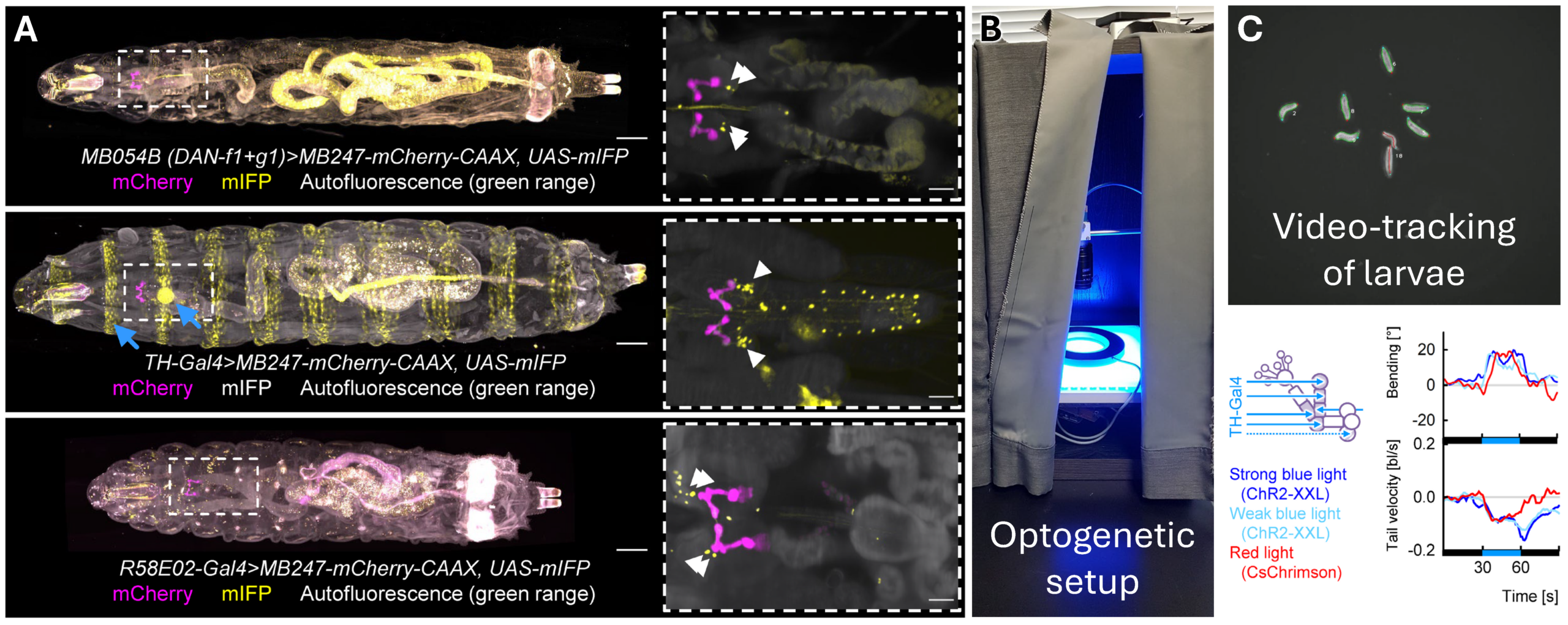
The Drosophila melanogaster larva is ideal for this purpose because it has only a few thousand nerve cells, and we have genetic tools that allow us to manipulate any gene, in any cell. We use optogenetic methods to artificially activate or deactivate specific neurons and study how these manipulations change the behavior that we are interested in. With these methods, we investigate how larvae learn, remember and use their memory for making decisions.
We are a small international group with a friendly, open atmosphere. We are always happy to welcome new students who want to join us in our research, or want to investigate their own, related research questions. Just contact me!
参考文献
- Rahman S, Tanaka NK, Schleyer M. 2026. Relative value learning in Drosophila melanogaster larvae. Proc R Soc B 293 (2064): 20252263
- Toshima N, Behrad A, Behnke F, Kaushik G, Weiglein A, Strauch M, Thoener J, Kobler O, Wang MLM, Dörr M, Schleyer M. 2025. Individual dopaminergic neurons induce unique, yet overlapping combinations of behavioural modulations including safety learning, memory retrieval and acute locomotion. eLife 14: RP106148. DOI: https://doi.org/10.7554/eLife.106148.1
- Thane M, Paisios E, Stöter T, Krüger A-R, Gläss, Dahse A-K, Scholz N, Gerber B, Lehmann DJ, Schleyer M. 2023. High-resolution analysis of individual Drosophila melanogaster larvae uncovers individual variability in locomotion and its neurogenetic modulation. Open Biol 13: 220308. DOI: https://doi.org/10.1098/rsob.220308
- Schleyer M, Weiglein A, Thoener J, Strauch M, Hartenstein V, Kantar Weigelt M, Schuller S, Saumweber T, Eichler K, Rohwedder A, Merhof D, Zlatic M, Thum AS, Gerber B. 2020. Identification of dopaminergic neurons that can both establish associative memory and acutely terminate its behavioral expression. J Neurosci 40:5990-6006.
- Saumweber T=, Rohwedder A=, Schleyer M=, Eichler K, Chen YC, Aso Y, Cardona A, Eschbach C, Kobler O, Voigt A, Durairaja A, Mancini N, Zlatic M, Truman JW, Thum AS, Gerber B. 2018. Functional architecture of reward learning in mushroom body extrinsic neurons of larval Drosophila. Nat Commun 9:1104.
学習
行動学では、学習は、「経験による行動の変化」と定義されます。(水波誠)
閉じる
記憶
経験による神経系の変容を保持する過程。記憶は脳の特定の領域でニューロン間のシナプス伝達効率の変化として保持されます。(水波誠)
閉じる
昆虫
全生物種の半数以上を占め、最も成功し繁栄しているグループです。体は頭・胸・腹に分かれており、胸には脚と翅があります(翅のないものや退化したものあり)。種類が多く、極地から熱帯、地中・地上・水中など様々な環境に適応し多様化しています。(滝谷重治)
我々が現在認識している生物種全体の半分以上の割合を占める多様な生物群です。彼らの進化の道筋を解明することは、自然界における生物多様性の起源の相当部分を説明すると期待されます。(加藤徹)
昆虫の種数は全動物種の2/3に及びます。昆虫は地球上で最も繁栄している動物群です。私は、その繁栄の秘密の一端は、小さくても精妙なその脳の働きにあると考えています。(水波誠)
閉じる
光遺伝学
閉じる
動画解析
閉じる
意思決定
閉じる
行動の動機づけ
閉じる
においと味
閉じる
ドーパミン
閉じる
キイロショウジョウバエ
閉じる
![[atmark]](https://www2.sci.hokudai.ac.jp/dept/bio/wp/wp-content/themes/sci-bio_2407/img/atmark.png)
 教員一覧
教員一覧