The Chicxulub impact signature in East Asia
Joint press release (in Japanese) by Tohoku University, The University of Tokyo, Fukui Prefectural University, Aichi University of Education, Hokkaido University, Hirosaki University, JAMSTEC, Institute of Science Tokyo, University of Tsukuba
Abstract
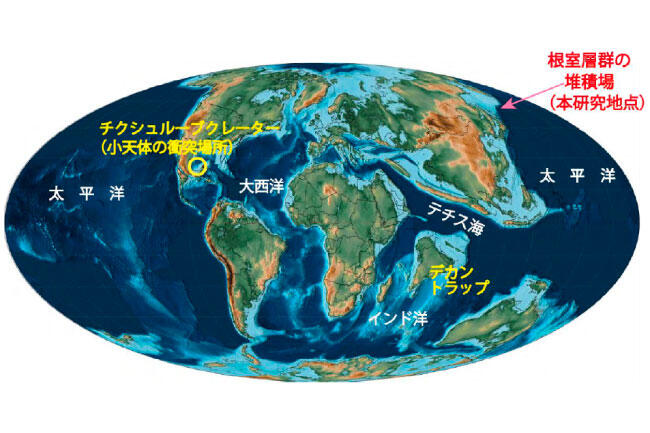
The Cretaceous-Paleogene boundary is defined by an asteroid impact at 66 million years ago at Chicxulub, Mexico. Despite extensive documentation worldwide, this boundary has not been clearly identified in East Asia, leaving a geographic gap in evaluating the global extent of impact records. Here we report a pronounced increase in osmium concentrations accompanied by a sharp decrease in 187Os/188Os ratios at the Kawaruppu section in the Nemuro Group, Hokkaido, Japan, which are indicative of the Chicxulub impact. These geochemical signatures are….
Read more on Communications Earth & Environments
Article Information:
Hayu Ota, Junichiro Kuroda, Keiichi Hayashi, Hiroyuki Hoshi, Ken Sawada, Kohei Hosogaya, Hiroshi Nishi, Akira Ishikawa, Katsuhiko Suzuki, Masashi A. Ikeda, Yuji Orihashi, Mark Schmitz, Babu Ram Gyawali, Hironao Matsumoto & Reishi Takashima, The Chicxulub impact signature in East Asia, Communications Earth & Environments, 7, 434 (2026)
DOI:10.1038/s43247-026-03602-z