Extended tetracyclic diterpanes and pimarane-type diterpenoids from Lower Cretaceous plant fossils (Kitadani Formation, Japan): chemotaxonomic and diagenetic implications
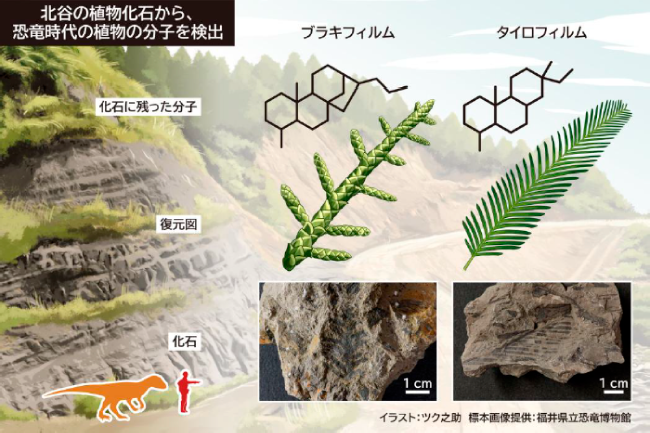
Joint press release (in Japanese) by Fukui Prefectural University, Fukui Prefectural Dinosaur Museum and Hokkaido University
Abstract
Aliphatic terpenoid biomarkers in four fossil plant samples from the Lower Cretaceous Kitadani Formation were analyzed by gas chromatography–mass spectrometry (GC–MS) to advance understanding of Mesozoic plant chemotaxonomy. Fossil–host rock comparisons were used to evaluate the indigenous origin of biomarkers. Gymnosperm fossils yielded much higher concentrations of n-alkanes and diterpenoids than fern fossils. Brachyphyllum showed a distinctive dominance of tetracyclic diterpanes, including homologues with elongated side-chain structures, whereas Ptilophyllum was enriched in pimarane-type diterpenoids. Fern fossils contained only trace amounts of terpenoids. Biomarker maturity indices (C31 hopane 22S/(22S + 22R) ≈ 0.62; MPI-1 and MPR-derived Rc ≈ 0.86%) indicate oil-window maturity. The selective enrichment of tetracyclic diterpanes in Brachyphyllum is consistent with non-Pinaceae conifers, while the pimarane dominance in Ptilophyllum suggests a Bennettitalean chemotaxonomic signal resembling conifers. The extended tetracyclic and pimarane diterpanes likely represent diagenetic products formed by thermal alkylation of conifer-type precursors; their structures remain tentative. These results….
Read more on Organic Geochemistry
Article Information:
Hiroki Yano, Hideto Nakamura, Hirokazu Yukawa, Extended tetracyclic diterpanes and pimarane-type diterpenoids from Lower Cretaceous plant fossils (Kitadani Formation, Japan): chemotaxonomic and diagenetic implications, Organic Geochemistry, 222 (2026), 105314
DOI:10.1016/j.orggeochem.2026.105314