Researcher Information

KON Fusako

Assistant Professor

Probing 'Shapes' of Electrons in Crystals Using Quantum Beams

Department of Physics, Electronic Condensed Matter Physics
basic_photo_1
Theme

1. Exploration of new uranium compounds
2. Microscopic study of f-electronic states using quantum beams

FieldElectrical Properties of Solids, Strongly Correlated Electron Systems, Low Temperature Physics
Keywordactinide/lanthanide compounds, 5f/4f electrons, magnetism, multipoles, quantum beams (synchrotron X-ray, neutron)

Introduction of Research

Uranium compounds are a group of materials that have received much attention as a platform for interesting physical phenomena, such as the coexistence of magnetism and superconductivity and hidden order. However, exploration of new uranium compounds still leaves a large unexplored regions, with the potential to reveal further novel physical phenomena.
In our laboratory, we are exploring new uranium compounds and performing microscopic experiments using quantum beams (synchrotron radiation X-rays and neutrons) to investigate the 5f electronic state, which is the key to understanding the physical properties of uranium compounds.

Academic degreePh. D. (Science)
Affiliated academic societyThe Physical Society of Japan, The Japanese Society for Neutron Science
Room addressFaculty of Science (Bldg. 2) 2-206

Department of Physics, Electronic Condensed Matter Physics

KON Fusako

Assistant Professor

basic_photo_1
What is your dream that you want to achieve through your research?

My dream is to discover exotic compounds that cannot be explained by any existing theory. The substances containing U atom that I study include anomalous materials, such as URu2Si2 that undergoes a phase transition into a mysterious ordered state called “hidden order,” and UTe2 that exhibits superconductivity under high magnetic fields. I aim to find such remarkable materials by myself.

basic_photo_1
Who is the researcher you respect most and why?

The researcher I most respect is Marie Curie, a pioneering figure in the field of radiation science. Despite facing numerous challenges—financial difficulties, discrimination against female scientists, and the hazards of radiation— she remained devoted to scientific research, and her dedication continues to be widely admired today. A phrase often cited as reflecting her life and spirit is: “On ne doit rien craindre dans la vie – il suffit de comprendre.” (Nothing in life is to be feared, it is only to be understood.) Scientific research always involves many difficulties, but I hope to follow her example and continue challenging any difficulties—while prioritizing safety above all else.

basic_photo_1
What do you usually do when your research work gets stuck?

I do glasswork. Using a gas burner, I heat long glass tubes and form them into test tube shapes. They are used to vacuum-seal samples. It’s a good way to relax and clear my mind for me.

basic_photo_1
Please tell us about yourself; things you are good at, your favorites, hobbies, and daily routines.

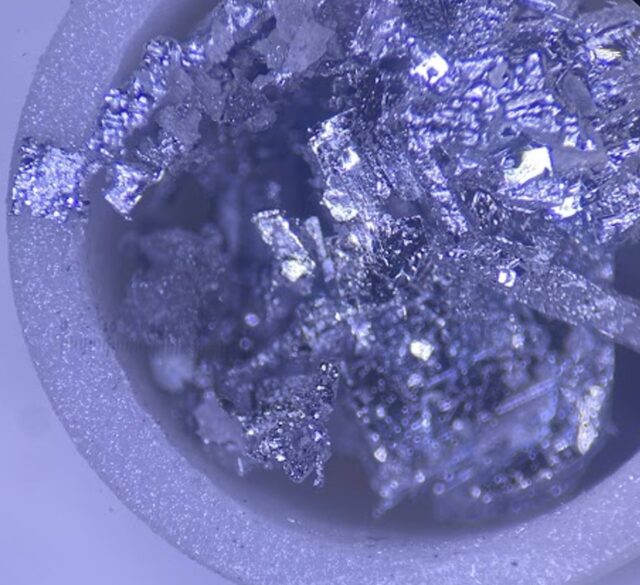
I really enjoy examining the inside of a crucible after taking it out of the furnace. To create new compounds, I load the starting materials into the crucible, heat them in the furnace, and cool them slowly to grow crystals. Once I remove the crucible from the furnace, I often end up spending hours searching for the crystals that have formed.

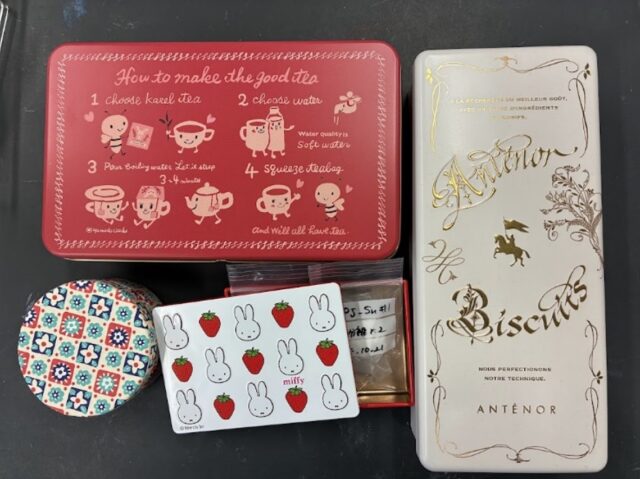
One of my hobbies is collecting cute cookie tins. I store the crystals picked up from the crucible in my favorite tins.

The inside of the crucible after removal from the furnace. Glittering crystals can be seen.
Part of my cookie tin collection. They are used to store synthesized crystals.
basic_photo_1

Link