
YAN, XiaochanAssistant Professor
What makes us who we are today? I address this question by decoding genomes to reconstruct how ecological pressures shape the evolution of phenotypic diversity, convergence, and adaptation across species.
Primates provide a powerful system for studying how ecological variation drives phenotypic diversification. My research focuses on phenotypic diversification, including dietary diversity and coat color evolution, integrating population genomics and comparative approaches to link genetic variation with adaptive phenotypes.
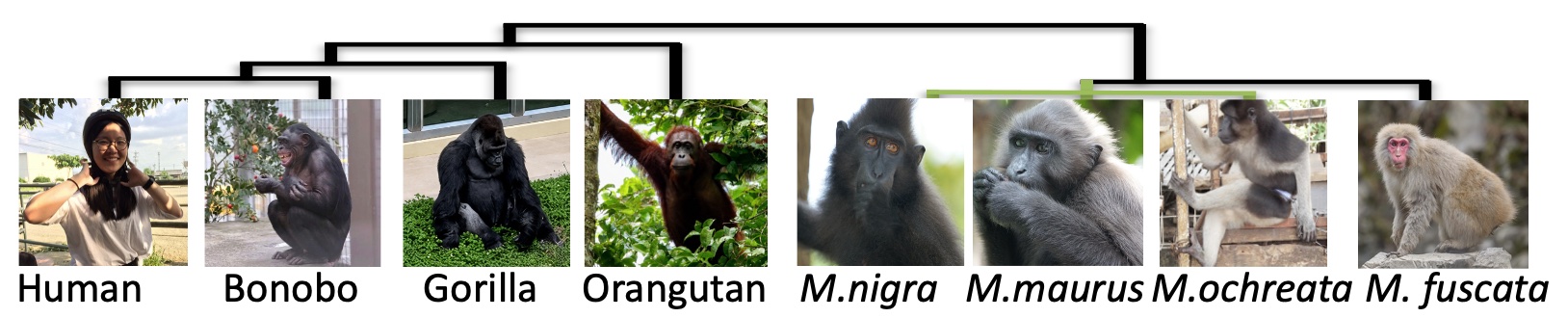
Importantly, I incorporate non-invasive field sampling, including fecal, saliva, and hair materials, enabling genomic studies of natural populations in wild environments. By combining these approaches, I aim to understand how ecological pressures shape the evolution of complex traits in natural populations.
Beyond primates, I am also interested in applying these evolutionary and genomic frameworks comparatively across diverse vertebrate systems.
Biodiversity is fundamental to life on Earth. I am fascinated by how and why biological diversity evolves across evolutionary timescales.
References
Mercuri, G., Caldon, M., Mutti, G., Imai, H., Yan, X., Shotake, T., Belay, G., Gippoliti, S., Capelli, C. Gelada genomic diversity sheds light on the biogeography of an endemic species of the Ethiopian highlands. Int J Primatol 47, 545–574 (2026). https://doi.org/10.1007/s10764-026-00556-z
Yan X., Terai Y., Widayati K.A., Purba L.H.P.S, Fahri F., Suryobroto B. & Imai H. “Exome-wide analysis reveals associations of novel DNA markers and coat color differentiation in five endemic Macaca species in Sulawesi Island”, BMC Ecology and Evolution, 25, 66 (2025). https://doi.org/10.1186/s12862-025-02407-6
Liu Z.*, Zhang X.*, Wang P.*, Hong M.*, Yan X.*, Qi X., Zhao Q., Chen Z., Nie H., Li H., Li Z., Zhang L., Qi J., He C., Truong N.V., Le M.D, Nadler T., Imai H., Roos C., Li M. Living on the Rocks: Genomic analysis of limestone langurs provide novel insights into the adaptive evolution in extreme karst environments. Genomics, Proteomics & Bioinformatics, Volume 23, Issue 1 (2025). https://doi.org/10.1093/gpbjnl/qzaf007 (*co-first author)
Yan, X., Terai, Y., Widayati, K. A., Itoigawa, A., Purba, L. H. P. S., Fahri, F., Suryobroto, B., Imai, H. Functional divergence of the pigmentation gene melanocortin-1 receptor (MC1R) in six endemic Macaca species on Sulawesi Island. Scientific reports, 12(1), 1-11(2022). https://doi.org/10.1038/s41598-022-11681-z
Widayati, K. A.*, Yan, X.*, Suzuki‐Hashido, N., Itoigawa, A., Purba, L. H. P. S., Fahri, F., Terai, Y., Suryobroto, B., Imai, H. Functional divergence of the bitter receptor TAS2R38 in Sulawesi macaques. Ecology and evolution, 9(18), 10387-10403(2019). https://doi.org/10.1002/ece3.5557 (*co-first author)
Faculty
Faculty of Science
Department of Biological Sciences
Reproductive and Developmental Biology
Grad School
Graduate School of Life Science
Division of Life Science
Biosystems Science Course
Contact Information
Faculty of Science, Building #5 5-1103
Email: xiaochan.yan ![[atmark]](https://www2.sci.hokudai.ac.jp/dept/bio/wp/wp-content/themes/sci-bio_2407/img/atmark.png) oia.hokudai.ac.jp
oia.hokudai.ac.jp
 Teacher's Archive