
SAWADA, AkiraAssistant Professor
Long-term studies that follow every individually marked member of a population over decades are known as long-term marked-population studies. Such research accumulates multi-generational records that integrate phenotypic traits, genetic information, and detailed data on when, how, and how many offspring each individual produces. These datasets allow us to capture ongoing evolution, supported by empirical measurements of fitness. We conduct this type of long-term research on the Ryukyu Scops Owl in the Nansei Islands. Islands are often described as “natural laboratories of evolution” because their ecological simplicity and uniqueness provide ideal settings for studying evolutionary and ecological processes. Through intensive fieldwork on the basic ecology of the Ryukyu Scops Owl, we aim to understand the mechanisms of evolution that apply broadly across organisms. My particular interests include mate choice, population dynamics, and life-history evolution. Each year, we spend as much time as possible on the study island to carry out thorough field surveys. Because understanding the ecological context of the focal species is essential, we also investigate the island’s broader biota across taxonomic groups.
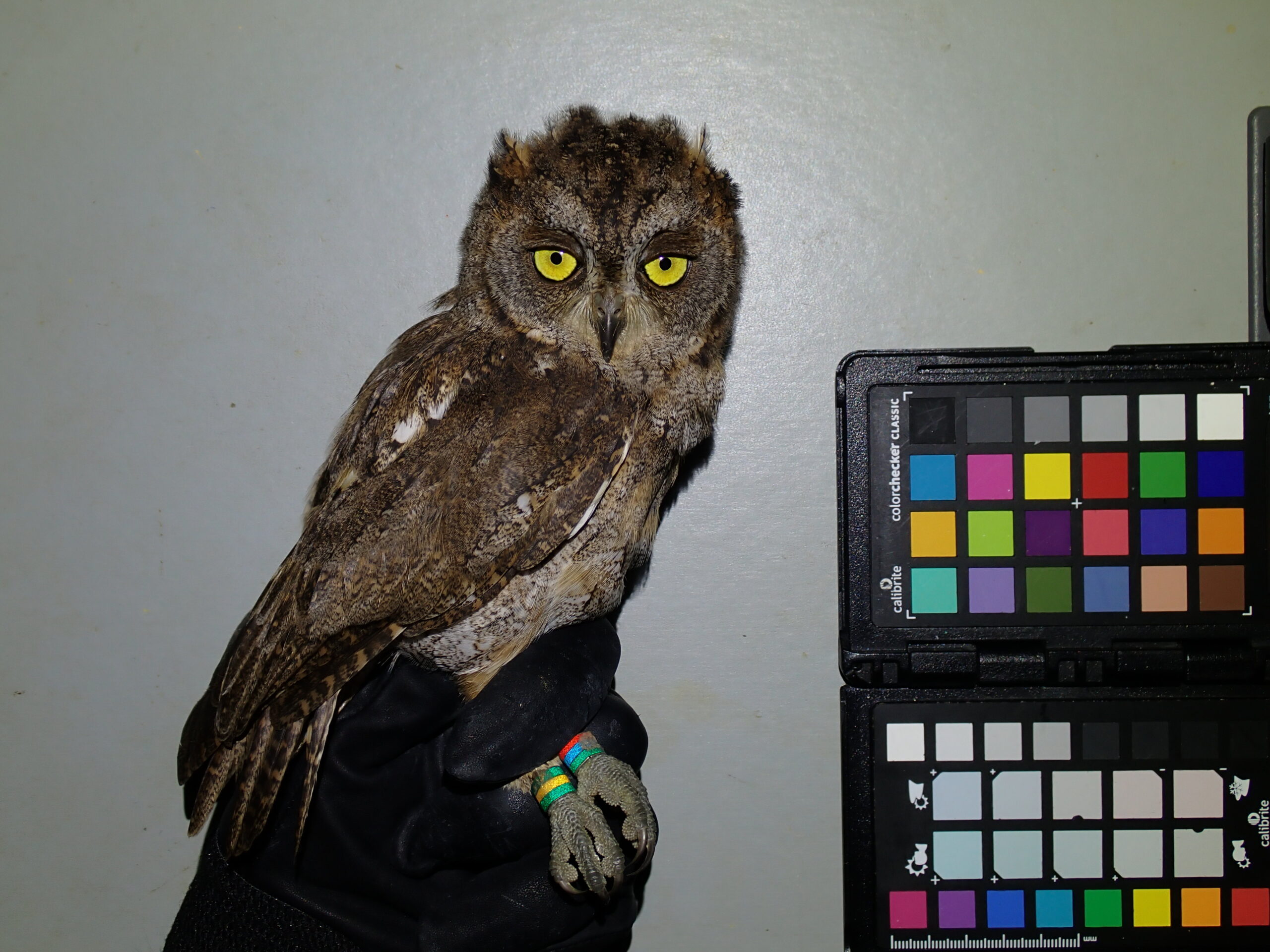
In an era of rapidly advancing analytical techniques and increasing pressure for short-term results, the value of maintaining long-term datasets and the infrastructure required to collect them is growing. Many key questions in ecology and evolutionary biology simply cannot be addressed without long-term data. This advantage will remain—unless someone invents a time machine that allows us to retrieve past data at will. Through our own research activities, we hope to demonstrate the importance of basic research and long-term perspectives. With a rich foundation of long-term data from a marked population, a wide range of research questions can be explored with creativity and insight of researchers. We invite you to join us in pursuing the limitless possibilities that long-term studies offer.
References
Sawada A. (2025). Japanese Weasels Mustela itatsi predate Ryukyu Scops Owls Otus elegans and Ruddy Kingfishers Halcyon coromanda in the Ryukyu Islands. Ornithological Science. 25(1): 97–104.
澤田明 (2024). ダイトウコノハズクの長期研究 標識が教えてくれること. どうぶつと動物園. 74(4): 20–25.
Sawada A., Iwasaki T., Akatani K & Takagi M. (2022). Mate choice for body size leads to size assortative mating in the Ryukyu Scops Owl Otus elegans. Ecology and Evolution. 12(12): e9578.
Sawada A., Iwasaki T., Inoue C., Nakaoka K., Nakanishi T., Sawada J., Aso N., Nagai S., Ono H. & Takagi M. (2021). Missing piece of top predator-based conservation: demographic analysis of an owl population on a remote subtropical island. Population Ecology. 63(3): 204–218.
Sawada A., Ando H. & Takagi M. (2020). Evaluating the existence and benefit of major histocompatibility complex-based mate choice in an isolated owl population. Journal of Evolutionary Biology. 33(6): 762–772.
Faculty
Faculty of Science
Department of Biological Sciences
Biodiversity
Grad School
Graduate School of Science
Department of Natural History Sciences
Biodiversity III
Contact Information
Faculty of Science, Building #5 5-513
Email: asawada ![[atmark]](https://www2.sci.hokudai.ac.jp/dept/bio/wp/wp-content/themes/sci-bio_2407/img/atmark.png) sci.hokudai.ac.jp
sci.hokudai.ac.jp
 Teacher's Archive