
SCHLEYER, MichaelAssistant Professor
We try to understand one of the biggest “Unknowns” in our world – the brain. Our brain controls our behavior and our body, yet despite great efforts we still have only a limited understanding of how it accomplishes its tasks. Our research therefore focusses on the much smaller and simpler brain of an invertebrate animal: the larva of the fruit fly Drosophila melanogaster. As part of our research, we test the cognitive limits of such a simple animal. We ask: what are the minimal requirements of a brain to be capable of learning, making decisions, and motivated, goal-directed behavior? And how does this simple brain accomplish these functions?
The Drosophila melanogaster larva is ideal for this purpose because it has only a few thousand nerve cells, and we have genetic tools that allow us to manipulate any gene, in any cell. We use optogenetic methods to artificially activate or deactivate specific neurons and study how these manipulations change the behavior that we are interested in. With these methods, we investigate how larvae learn, remember and use their memory for making decisions.
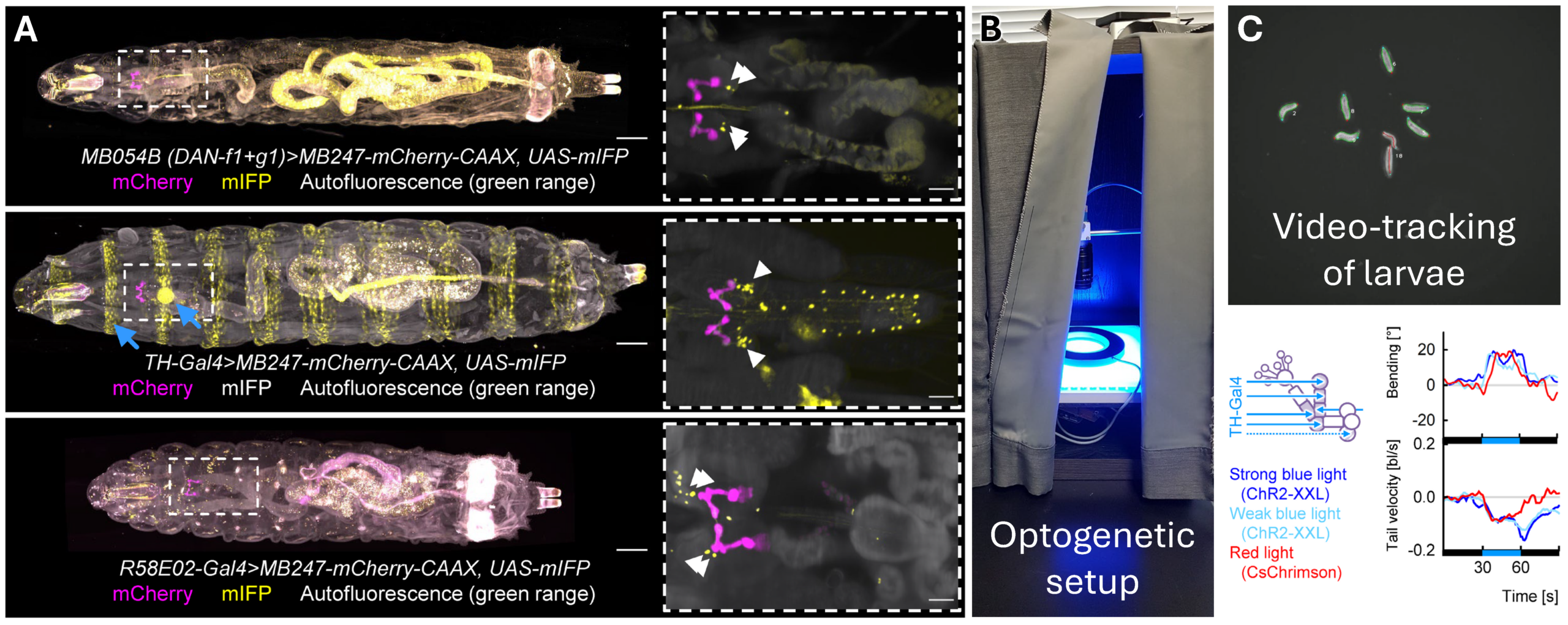
We are a small international group with a friendly, open atmosphere. We are always happy to welcome new students who want to join us in our research, or want to investigate their own, related research questions. Just contact me!
References
- Rahman S, Tanaka NK, Schleyer M. 2026. Relative value learning in Drosophila melanogaster larvae. Proc R Soc B 293 (2064): 20252263
- Toshima N, Behrad A, Behnke F, Kaushik G, Weiglein A, Strauch M, Thoener J, Kobler O, Wang MLM, Dörr M, Schleyer M. 2025. Individual dopaminergic neurons induce unique, yet overlapping combinations of behavioural modulations including safety learning, memory retrieval and acute locomotion. eLife 14: RP106148. DOI: https://doi.org/10.7554/eLife.106148.1
- Thane M, Paisios E, Stöter T, Krüger A-R, Gläss, Dahse A-K, Scholz N, Gerber B, Lehmann DJ, Schleyer M. 2023. High-resolution analysis of individual Drosophila melanogaster larvae uncovers individual variability in locomotion and its neurogenetic modulation. Open Biol 13: 220308. DOI: https://doi.org/10.1098/rsob.220308
- Schleyer M, Weiglein A, Thoener J, Strauch M, Hartenstein V, Kantar Weigelt M, Schuller S, Saumweber T, Eichler K, Rohwedder A, Merhof D, Zlatic M, Thum AS, Gerber B. 2020. Identification of dopaminergic neurons that can both establish associative memory and acutely terminate its behavioral expression. J Neurosci 40:5990-6006.
- Saumweber T=, Rohwedder A=, Schleyer M=, Eichler K, Chen YC, Aso Y, Cardona A, Eschbach C, Kobler O, Voigt A, Durairaja A, Mancini N, Zlatic M, Truman JW, Thum AS, Gerber B. 2018. Functional architecture of reward learning in mushroom body extrinsic neurons of larval Drosophila. Nat Commun 9:1104.
Website
Faculty
Faculty of Science
Department of Biological Sciences
Behavioral Neurobiology
Grad School
Graduate School of Life Science
Division of Life Science
Biosystems Science Course
Contact Information
Email: m.schleyer ![[atmark]](https://www2.sci.hokudai.ac.jp/dept/bio/wp/wp-content/themes/sci-bio_2407/img/atmark.png) oia.hokudai.ac.jp
oia.hokudai.ac.jp
 Teacher's Archive